

News
Access to Work cuts threat to Second Hand Dance - 7 October 2026
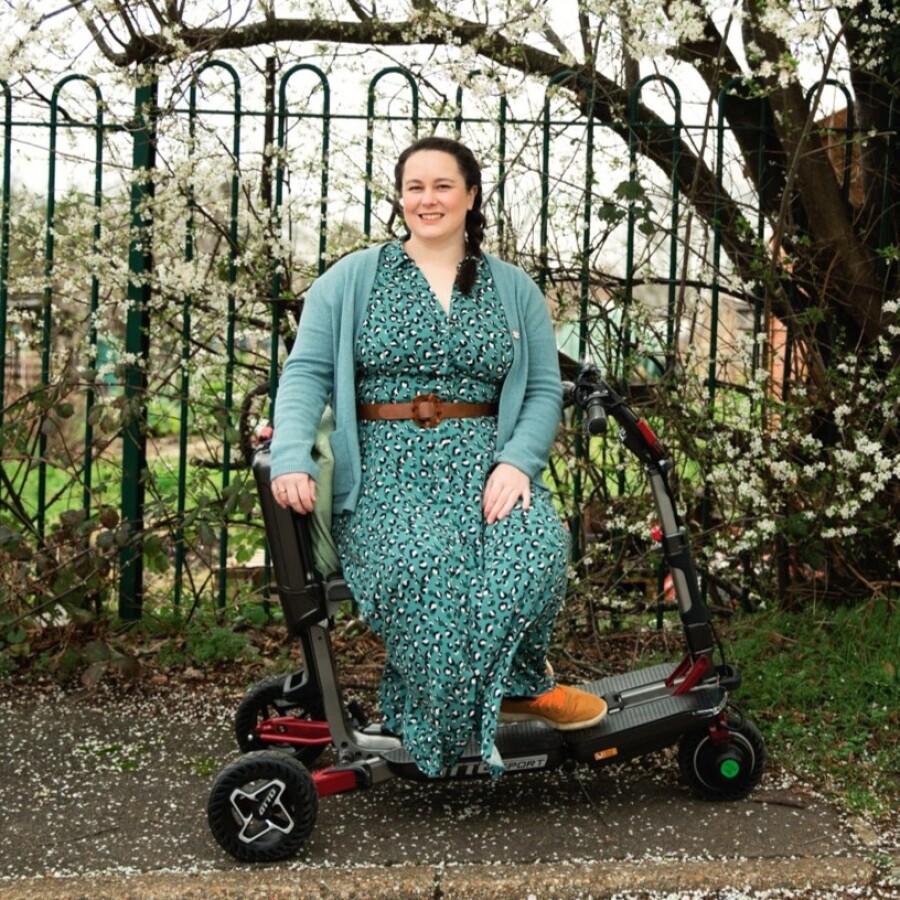
Rosie's Response to the Devastating Cuts
I'm Rosie Heafford Co-Director and Artistic Director of Second Hand Dance. I've been making dance for children and adults for over 15 years. I founded Second Hand Dance in 2013 and our work reaches disabled and non-disabled audiences around the world.
I've received support from Access to Work, a government scheme to support disabled people in work, since 2020. In September, over a month delayed since my previous grant ended, I received my Access to Work renewal decision for 2026/27.
My annual award has been cut by 76%.
This changes the level and nature of the support available to me, and it threatens my ability to continue in my role. My disability hasn't changed and nor has my job. None of this was raised with me during the renewal process, and it contradicts Access to Works Policy and the independent workplace assessment carried out as part of that renewal.
Second Hand Dance goes above and beyond to put in as many reasonable adjustments as possible for myself and other disabled staff to work accessibly. Access to Work’s purpose is to support beyond reasonable adjustments, so that disabled people can access and thrive in the workplace.
The new award drastically reduces Support Worker capacity and pay, along with all of my travel support.
I am not asking for enhanced support or support beyond what is required to do my job. I am asking for the minimum disability-related support that allows me to remain in my existing role, a role that requires me to work in rehearsal studios, schools, nurseries, outdoor environments, festivals and conferences across the UK and internationally. I simply cannot convert it into home-based working. The message is that disabled people should only do work that doesn't need travel assistance and shouldn't be doing work that connects them with artists and communities across the UK and the world.
Access to Work exists to make the workplace equitable for disabled people. The current Labour Government has made clear its ambition to support disabled people into work and to move away from a culture of economic “inactivity”. As recently as last month, Pat McFadden MP spoke of the importance of work, saying that being in work “is not just about earning a wage, vital though that is. It’s about pride and purpose. It’s about your identity. It’s about knowing you earned that money, you went out there and you worked for it” Labour Party Conference, 27 September 2026
Yet this ambition is in stark contrast to the decisions currently being made around Access to Work grants.
I'm devastated.
This doesn't only affect me. Second Hand Dance is a small team working with freelancers and creatives. What affects my ability to work affects them too. We have an incredible team and will keep working as best as we can to deliver the exciting programme we have planned.
Other disabled artists have spoken out before me, including Jess Thom and Jenny Sealey, and many more independent artists who haven’t been able to shout so loudly, but whose livelihoods have been decimated. I want to thank Graeae and Decode for all of the incredible ongoing work they are doing. I'm adding my voice because people need to see the agony these decisions are causing.
We are calling for Access to Work decisions to be based on the actual needs of disabled people in the workplace, the recommendations of appropriately qualified assessments, and the genuine cost of the skilled support required.
To our supporters, audiences, partners and friends. I’m asking for your support and allyship. Every share, conversation and act of support helps to keep this issue visible and strengthen the call for change.
Template letter to your MP:
Decode, Call to Action:
Additional reading:
Let Them Disrupt: Children as Co-Creators. Reflections of Rosie Heafford, edited by Emily Jameson - 11 June 2026
I’m often asked when, and how, my artistic practice became defined in its methodology of co-creation.
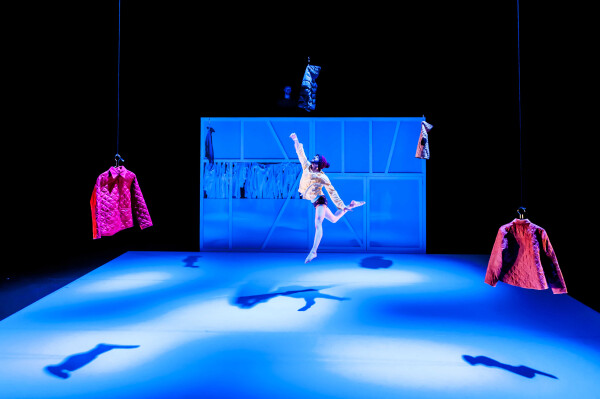
In 2015 I worked as movement director on 16 Singers, a show for babies directed by Kitty Morley and produced by The Egg and Dance Umbrella. Kitty taught me a great deal about creating work for the very youngest audiences and 16 Singers was a show that centred stillness and breath. I was also developing Second Hand Dance’s Getting Dressed, which by comparison, was a bold production with an 80s soundtrack and large set, on a traditional stage with raked seating that in contrast felt quite distant from the performers. I found myself craving something smaller, closer, more intimate—something that invited movement from the audience.
Watching children’s performances at that time, I became increasingly aware of an expectation that children should simply watch and listen. They were often required to be still and passive, rather than fully embodying their experience. This awareness informed the research & development for my next show We Touch, We Play, We Dance. I wanted to explore contact improvisation with children in nursery settings. I felt that children were already expert improvisers and artists—constantly moving, initiating contact, responding and shaping their world around them.
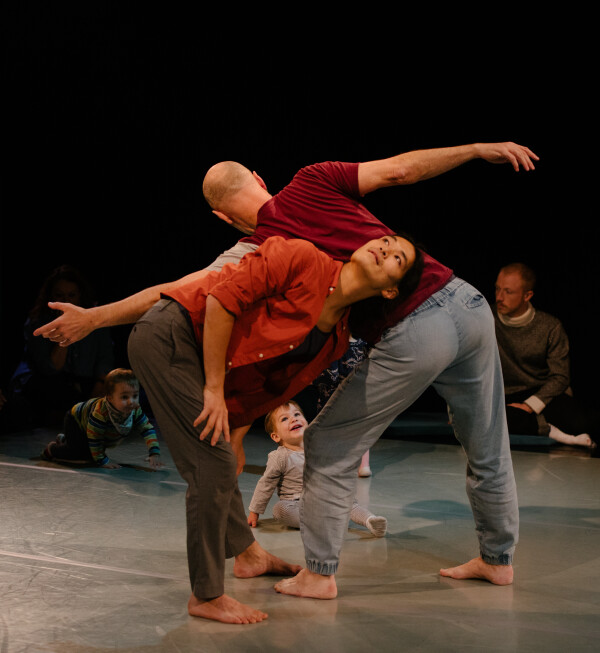
Throughout the R&D, we were embedded for two weeks in nurseries in Camberley and Roehampton, dancing with different groups of children each morning. Slowly, what unfolded in those spaces began to take shape as something quite extraordinary. A collaborative creation process emerged between the children and our group of exceptional dancers, all curious and open to exploring score-based improvisation. We quickly learnt that as much as the dancers were giving ideas to the audience (the children), they were offering ideas to us. Each afternoon we would reflect and develop our choreography and movement offers. The dancers became skilled at responding to what they saw—taking movement from the children and shaping it into shared worlds and the beginnings of a movement score, co-created in real time.
That was the starting point, and it has continued to grow over the years. It was a process I felt deeply excited by. A process full of possibility, although it has taken time to understand why it feels so right and so necessary.
A visceral, deeply human connection
Co-creating with young audiences prioritises the body. It centres a visceral experience and places the audience—their impulses, desires, and ways of being—at the heart of the work. The babies’ and children’s urge to move, to vocalise and to feel, becomes part of the performance landscape—becoming the material of improvisation itself.
For me, that felt profoundly validating.
As my practice developed, I began exploring mirror neurons—brain cells that activate both when we perform an action and when we observe it. Mirror neurons interest me as they are fundamental to how babies learn in the world. Babies see their mother smiling, and they smile in response. It’s a deeply human form of connection.
This emphasis on visceral movement, and on improvisation as a way of inviting children to explore and express themselves, has become central to my practice. It has also deepened alongside my growing understanding of disability and neurodivergence. My perspective is shaped both by my own disabled experience, neurodivergent family, and by wider writing on disability justice, sensory practice and the neurodiversity paradigm.
Through experimenting with co-creation, my sense of the body—its “viscerality”, its sensory awareness—has expanded. It has deepened my understanding of how bodies perceive, respond to, and feed back into performance.
A movement process defined
With time, I gradually recognised co-creation as an iterative process – where outcomes don’t emerge fully formed, but evolve through cycles of observation, feedback and adjustment.
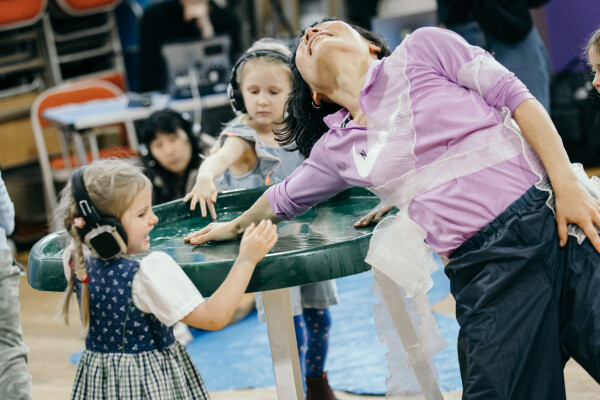
In the studio, we always begin with a theme—an intention. For We Touch, We Play, We Dance for example, it was very much about contact and touch as a starting point. Our new show about water and rhythm, begins with water as texture, metaphor, and dramaturgy. Through moving together with children, we explore these ideas, gradually creating the dramaturgy collaboratively. It isn’t about me deciding what happens; the children shape the work through their embodied responses—by being with us, offering movement, and sharing ideas. The process is iterative: we begin with rough sketches and slowly build detail with them, improvising together and discovering something new each time.
In terms of co-creation, access-led practice, and disability-affirming work, this approach creates a way of working that is non-linear and tangential. Rather than moving in a straight line, it circles and spirals, allowing ideas to begin as something vague and cloud-like, with multiple layers. And those ideas gradually come together into something more coherent through improvisation. Movement becomes a form of knowledge. We begin to value kinaesthetic play, sensation, and embodiment alongside linear, written, or spoken forms.
Movement also becomes a way of relating. What we develop through our processes and performances is a live, evolving relationship with the audiences—both adults and children. They are invited into the work and actively shape it as it unfolds.
Attending to children
In European and North American contexts, attention during learning or performance is often defined as stillness—watching and listening quietly. But through years of working in this way, I’ve observed children engage in a variety of ways, with only some conforming to that expectation.
I’m particularly interested in children who disrupt adult expectations of watching performances – moving through the space, shaping sculptures from tape, stimming and vocalising. There was a really beautiful and clarifying moment in a performance of The Sticky Dance two years ago at The Gulbenkian. It was a Sensory Groovers version of the show, so a lower capacity audience with maybe eight or nine children in the space.
There was a mother with two boys, and one boy was engaged in ways you might typically expect—responding to our invitations and participating quite directly. The other was drawn elsewhere: to the edges of the space, to the darker corners, to the technology in the room. His mother seemed to find this quite difficult, but for me it was honestly one of the most beautiful things that I've seen. Although he didn’t appear to be watching or engaging in a conventional way, he was clearly sensing the work—feeling the tape, absorbing the music, attuning to the atmosphere of the space.
At the end of the performance, as the performers lay down and much of the audience followed, he did something extraordinary. He had gathered pieces of tape we’d been using - something others in the group had explored earlier - made a kind of hat and placed it on his head, then walked through the space as if he were a new sticky dance monster. And he sung, using his voice in a melodic way, moving across the room before eventually kneeling and lying down.
That moment stayed with me. It showed the importance of allowing him to be present on his own terms. Even though I hadn’t seen him “watch” in a conventional sense, he had taken in the visual language, the movement, and the music. What he had created emerged from the world of the performance—it was his way of expressing that he had been there, fully engaged in his own way.
I think this co-creative way of working has really pushed me to question what we, as adults, expect of children—particularly in terms of attention. What do we assume they should be doing, and when they do something unexpected, why is that?
This has become central to my artistic practice: a sustained process of observation, and of gently shaping what happens at the edges—how performers improvise and respond in the moment. In that sense, it’s also a practice of making performance more accessible. Not all children (or adults) can sit cross-legged, still and attentive, in a dark theatre.
Rosie is delivering a workshop as part of People Dancing’s Summer Programme on Wednesday 22 July. The workshop Producing, Co-creation & Inclusion in Performance for Children, takes place at De Montfort University, Leicester. Find out more and apply here.
Image credits from top: Water R&D, Earlsfield Library, Nov 25. Photo by Lukasz Izdebski. | We Touch, We Play, We Dance, 2019. Photo by Zoe Manders. | Getting Dressed, 2017. Photo by Lydia Crisafulli.